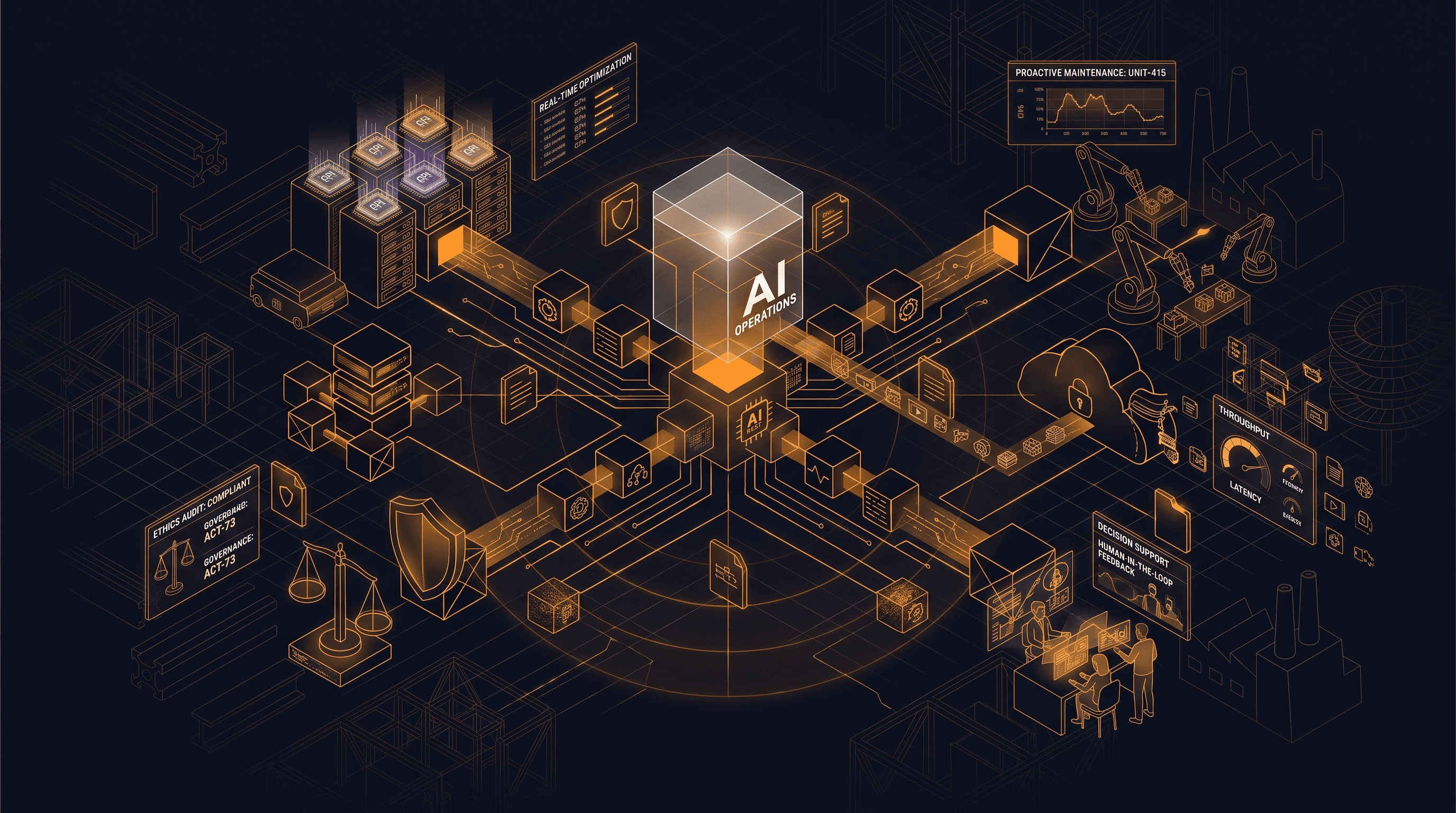
"AI operations" is not a chatbot on your website
Most small and mid-sized businesses have already tried the version of AI that shows up as a chat widget in the corner of a website, answering generic questions from a generic script. That's not what AI operations means.
AI operations is an AI agent trained specifically on your company, your product catalog, your pricing, your documents, your workflows, deployed to run the repetitive, time-consuming work that currently depends on a person doing it manually, one request at a time. The difference isn't the technology under the hood; it's what the system actually knows and what it's allowed to do.
What an operations-focused AI agent actually does
In practice, this looks less like "chat with our AI" and more like infrastructure working quietly in the background:
- Instant quoting from your full catalog. Instead of someone manually looking up prices, checking stock, and typing a quote by hand, the agent generates it in minutes from your actual product data; even across a catalog of thousands of SKUs.
- Unlocking data trapped in legacy software. Many manufacturers run on systems built decades ago, with data that's technically there but practically unreachable without a specialist. An AI agent can sit on top of that legacy data and make it usable again, searchable, reportable, connected to modern tools.
- Automating the repetitive work behind the operation. Order processing, document generation, status updates, follow-ups, the tasks that eat a team's time without requiring real judgment calls.
- Running continuously, not on business hours. A monitoring or quoting agent doesn't stop at 5pm. If a request comes in overnight, it's already handled by morning.
Why "trained on your data" is the part that matters
A generic AI tool can hold a conversation. It can't quote your product #4471 correctly, because it doesn't know your product #4471 exists. The value of AI operations comes specifically from connecting the model to:
- Your actual product or service catalog
- Your real pricing logic, including any tiers, discounts, or client-specific terms
- Your existing documents, spec sheets, past quotes, contracts, compliance records
- The systems you already use, instead of asking your team to adopt a new one
This is also why AI operations projects don't start with the AI, they start with an audit of what data exists, where it lives, and how clean it actually is. The agent is only as useful as the data it's built on.
What this looks like end to end
- Assessment. Map what the business actually does day to day, and identify which parts are repetitive, rules-based, and currently eating staff time.
- Data unification. Pull the relevant data, catalog, pricing, historical records out of whatever legacy system or spreadsheet it currently lives in, and structure it so an AI agent can actually use it.
- Agent deployment. Build and train the agent specifically on that data, scoped to the tasks it's meant to handle, quoting, monitoring, document generation, or a combination.
- Automation layer. Connect the agent to the actual workflow, so its output doesn't require a manual copy-paste step to become useful, it plugs directly into what the team already does.
A real example
At GIC Aluminum, a 44-year-old aluminum manufacturer in Hialeah Gardens, Florida, the operations problem wasn't a lack of demand, it was that quoting from their full catalog took too long to compete for time-sensitive opportunities, including government bids with tight response windows.
We built a live quoting engine trained on their entire 1,552-product catalog, so a quote that used to take substantial manual lookup now takes minutes. That same automation layer also powers 24/7 bid monitoring across federal, state, and county procurement portals, meaning the business never misses a relevant opportunity just because nobody was watching the board at the right moment.
Where this fits for a business that "isn't a tech company"
Most companies that benefit most from AI operations don't think of themselves as AI-ready. They're manufacturers, distributors, service providers, businesses where the founder or ops manager is the one who currently knows where everything is, because it's not written down anywhere a system could read it.
That's precisely the gap AI operations closes: not replacing the expertise in someone's head, but capturing it into a system that can act on it consistently, at any hour, without requiring that one person to personally handle every request.
Bottom line
If the phrase "AI operations" makes you picture a chatbot, it's worth resetting that picture. Done properly, it's an agent that knows your catalog, your pricing, and your paperwork well enough to do the repetitive parts of the job, freeing your team for the parts that actually need a person.
Increment AI Group builds AI agents trained on your own catalog, pricing, and documents, plus the automation behind them, from instant quoting to legacy data recovery to 24/7 monitoring. Request a free assessment to see what we'd automate first in your operation.